
Planning Permission for Padel Courts in the UK: Timelines, Requirements, and What to Expect
Padel is one of the fastest growing sports in the UK, and with that growth comes a sharp increase in new court developments across leisure centres, private clubs, schools, and commercial sites.
While padel courts are relatively compact compared to other sports facilities, they are still classed as development under UK planning law. In most cases, planning permission will be required, particularly for outdoor courts, floodlit installations, or sites close to residential areas.
This guide explains how planning permission for padel courts works in the UK, how long the process typically takes, what assessments are commonly required, and what causes delays or refusals. It is not legal advice, but a practical overview based on current UK planning practice.
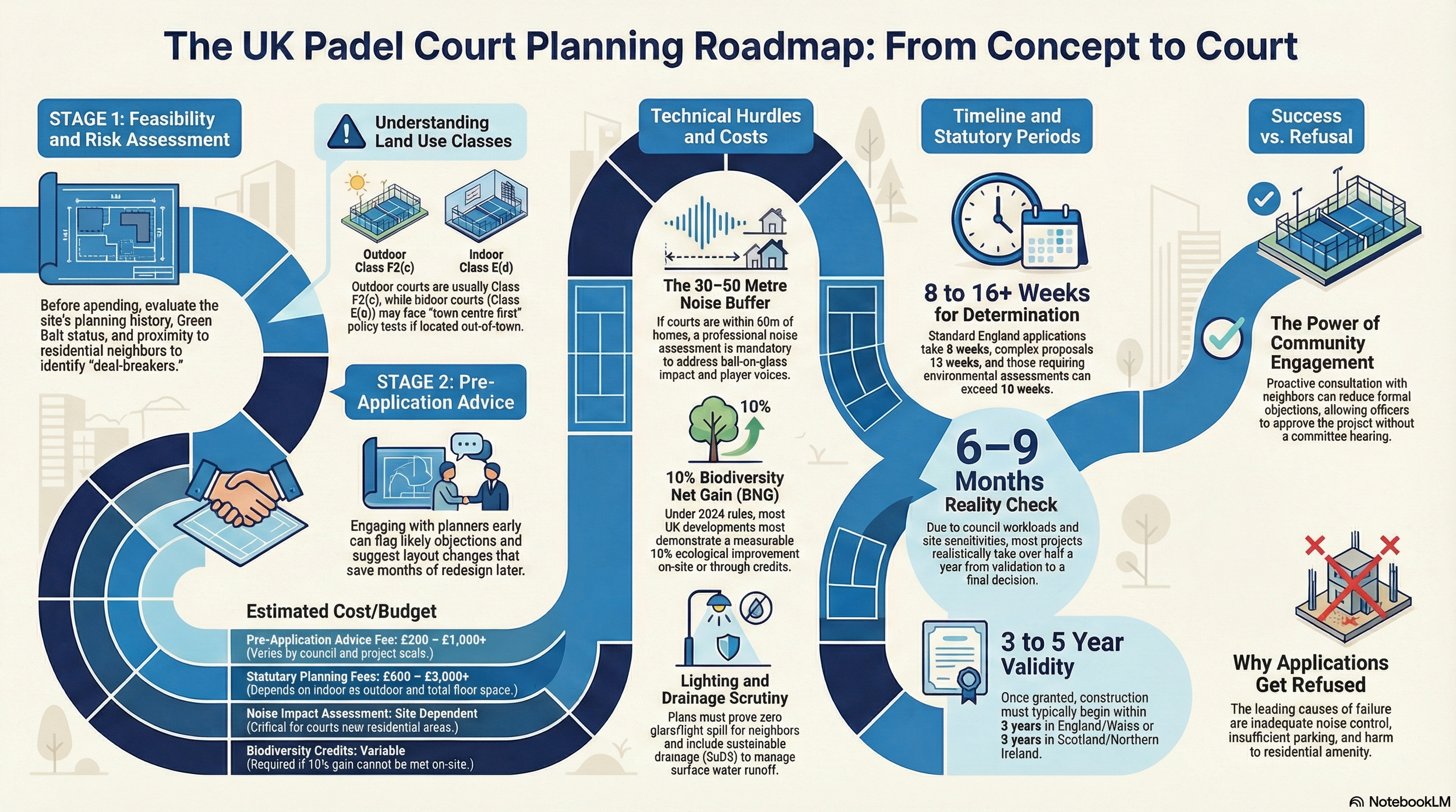
1. How Long Does Planning Permission for a Padel Court Take?
For most padel court projects in England, the statutory determination period is:
8 weeks for straightforward applications
Up to 13 weeks for more complex proposals
16 weeks or longer if environmental assessments are required
These timelines begin once the application has been validated by the local planning authority, not from the date it is submitted.
In Scotland, planning authorities aim to determine:
Local developments within 2 months
Major developments within 4 months
In practice, actual decision times depend heavily on council workload, site sensitivity, and the quality of the application. Many development types now routinely take 6–9 months or longer from validation to decision, especially where further information is requested or applications go to committee.
Once planning permission is granted, it is typically valid for 3 years in England and Wales, meaning construction must begin within that period. In Scotland and Northern Ireland, permissions can run longer (often up to 5 years) where agreed by the planning authority, so local rules should always be checked.
2. Planning Permission vs Use Class for Padel Courts
Padel courts are assessed under planning law based on both physical development and land use.
In most cases:
Outdoor padel courts fall under Class F2(c), outdoor sport and recreation
Indoor padel courts fall under Class E(d), indoor sport and recreation
If the site already has an established sporting or leisure use, planning permission may be more straightforward. Where the proposal involves a material change of use, such as converting agricultural or commercial land into a sports facility, additional scrutiny applies.
For indoor padel facilities, Class E(d) is treated as a “main town centre use,” which means proposals on out‑of‑centre sites can be subject to the sequential test and town centre first policies, particularly for larger commercial clubs. This can significantly influence site selection and planning risk.
3. Stage One: Site Feasibility and Planning Risk Assessment
Before submitting any application, a feasibility assessment is strongly advised. This stage identifies planning risks early and avoids unnecessary expenditure later.
Key considerations include:
Planning history of the site
Local plan designations
Proximity to residential properties
Green Belt, conservation area, or flood zone status
Existing access and parking provision
Sites within Green Belt or conservation areas are not automatically ruled out, but they face stricter tests around visual impact, openness, and public benefit.
4. Stage Two: Pre-Application Advice from the Local Authority
Most councils offer a pre-application advice service. While optional, it is one of the most effective ways to reduce planning delays or refusals.
Through pre-application engagement, planners will usually:
Confirm whether permission is required
Identify required technical assessments
Flag likely objections or constraints
Suggest design or layout changes
Fees typically range from around £200 to well over £1,000 depending on council and project scale, with higher charges common for commercial or multi‑court schemes. While this is an upfront cost, it often saves months of delay and redesign later.
5. Technical Assessments Commonly Required for Padel Courts
The exact documentation required depends on the site, but padel court applications frequently include the following.
5.1. Noise Impact Assessment
Noise is the most common concern raised by planning authorities and residents.
Padel courts generate:
Ball impact noise on glass
Player voices
Repetitive sound patterns
Courts within roughly 30 to 50 metres of residential properties usually require a professional noise assessment. This assesses baseline noise levels, predicts court activity impact, and proposes mitigation measures such as acoustic fencing, court orientation, or restricted hours.
Failure to address noise properly is one of the leading causes of refusal.
5.2. Lighting Impact Assessment
Floodlit courts require a lighting study to demonstrate:
Limited light spill beyond site boundaries
No unacceptable glare
Compliance with environmental lighting guidance
Modern LED systems with directional control typically perform well when correctly designed. Poor lighting design is a frequent reason for planning conditions or refusal.
5.3. Ecology and Biodiversity Net Gain
Under Biodiversity Net Gain rules introduced nationally in 2024, many developments must demonstrate measurable ecological improvement. Major developments have been in scope since 12 February 2024, with most small sites brought in from 2 April 2024.
Padel court projects may require:
Ecological surveys
Habitat assessments
Landscaping or planting proposals
Off-site biodiversity credits
In England, most qualifying schemes must deliver at least a 10% biodiversity net gain, secured by condition or legal agreement. Early ecological input avoids delays caused by unexpected findings later in the process.
5.4. Drainage and Surface Water Strategy
Artificial turf courts must demonstrate adequate drainage and surface water management.
Planning authorities expect:
Sustainable drainage solutions
No increased flood risk
Controlled runoff rates
Sites in flood zones or with known drainage constraints face higher scrutiny.
5.5. Highways and Parking Assessment
Where padel courts introduce new users to a site, councils will assess:
Access safety
Traffic generation
Parking provision
Inadequate parking is another common refusal reason. Authorities will expect realistic parking demand calculations, particularly for commercial or club facilities.
6. Community Engagement and Managing Objections
Although not mandatory, community consultation can significantly influence outcomes.
Early engagement with:
Immediate neighbours
Local residents’ groups
Schools or sports clubs
can reduce objections and generate support letters. Applications with minimal objections are more likely to be approved under delegated powers, avoiding committee delays.
7. Application Submission and Validation
A complete application typically includes:
Site layout plans
Court elevations and sections
Design and Access Statement
Planning Statement
Technical assessments
Lighting and materials details
Incomplete submissions delay validation and extend timelines. Referencing pre-application advice and demonstrating how concerns have been addressed improves credibility.
Planning fees for padel court projects now typically range from around £600 to £3,000+ depending on whether the courts are indoor or outdoor, the site area, and the floorspace created. For example, “other operations” on land are charged per 0.1 hectare with an upper cap, while new sports buildings are charged per 75 sqm, and some not‑for‑profit sports clubs on playing fields benefit from a reduced capped fee.
8. Determination, Committees, and Decision Making
Once validated, planning officers assess the proposal against:
Local plan policies
National planning guidance
Residential amenity considerations
Straightforward applications are usually decided by officers. Applications with objections, policy conflicts, or sensitive locations may be referred to committee, extending the process by several weeks.
9. Conditions and Post-Approval Requirements
Planning permission for padel courts almost always includes conditions.
Common conditions include:
Noise mitigation implementation
Lighting specifications
Landscaping details
Drainage approval
Some conditions must be discharged before construction begins. Starting work without satisfying pre-commencement conditions can lead to enforcement action.
10. Why Padel Court Applications Are Refused
The most common refusal reasons are:
Inadequate noise control
Insufficient parking
Harm to residential amenity
Visual impact in sensitive locations
Failure to demonstrate biodiversity compliance
Most refusals can be avoided through proper assessment and early planning strategy.
11. Planning Permission Strategy for Padel Courts
A realistic planning programme should allow:
3 to 6 months for straightforward sites
6 to 12 months for constrained or sensitive locations
Applications submitted with comprehensive technical evidence, clear drawings, and proactive mitigation measures stand a far higher chance of approval.
Local planning interpretation varies significantly across the UK. What works in one authority may not in another, making local planning experience critical.
12. Summary
Planning permission is a critical part of any padel court project in the UK. While the statutory process appears simple, delays and refusals often arise from noise concerns, lighting design, parking provision, biodiversity obligations, or incomplete applications.
By understanding how planners assess padel courts, engaging early with local authorities, and addressing technical requirements upfront, most projects can progress smoothly.
This article provides a general overview of UK planning considerations. For site-specific advice, local authority guidance or professional planning support should always be consulted.
