
Padel is a dynamic racket sport combining elements of tennis and squash, typically played in doubles on an enclosed court. Recognized as one of the world’s fastest-growing sports, it has expanded from a private backyard in Acapulco, Mexico, to organised play across more than 90 countries.
The Invention: Enrique Corcuera’s Backyard Solution
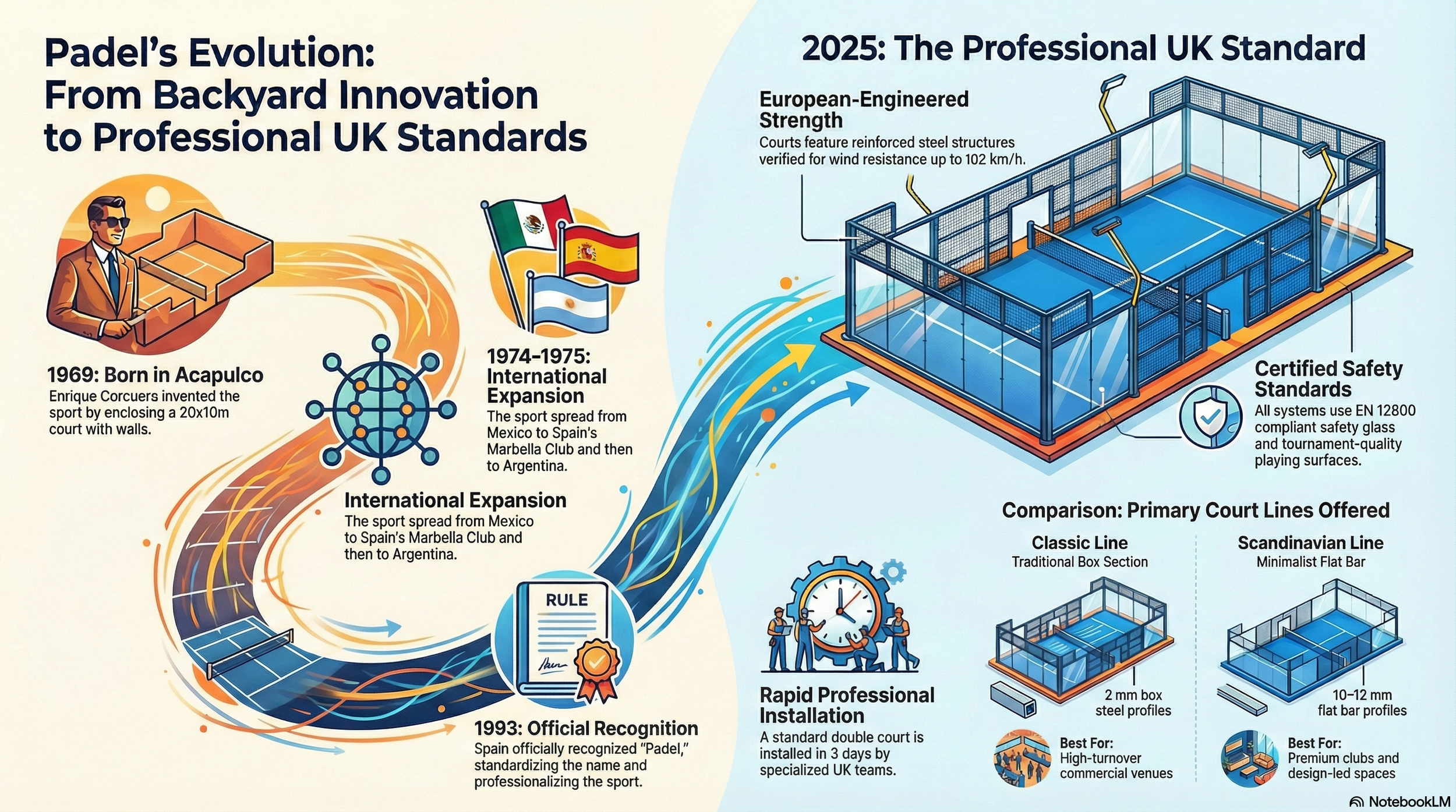
Mexican businessman Enrique Corcuera invented padel in 1969 at his holiday home in Acapulco. Limited space prevented him from building a standard tennis court, so he adapted an existing 20 x 10 metre area, enclosing it with walls and metal fencing. This design allowed the ball to rebound off the walls, borrowing from squash while preventing balls from leaving the property.
Corcuera originally named the sport “Paddle Corcuera.” His improvised solution created a new format that was more social, more compact, and easier to pick up than traditional tennis, laying the foundations for modern padel.
Nautical Roots and the “Paddle” Name
The name derives from the English word “paddle,” referencing the solid, stringless rackets used in play. Its deeper roots stretch back to the 19th century, when British cruise ship passengers played racket games on enclosed deck courts, and to platform tennis in the United States.
In the 1910s and 1920s, platform tennis became popular in New York and Washington. It used paddles, elevated courts, and fences to keep the ball in play during winter, with walls and wire mesh forming part of the playing surface. Corcuera drew inspiration from these concepts, adapting them to his walled Acapulco court and combining them with tennis scoring and tactics.
Expansion to Spain and Argentina
Padel’s international growth began through Corcuera’s social circle. In 1974, Alfonso de Hohenlohe, after experiencing Corcuera’s court in Mexico, built the first two padel courts in Spain at the Marbella Club on the Costa del Sol. The sport quickly gained popularity among the Spanish elite and spread along the Mediterranean coast.
In 1975, Argentine businessman Julio Menditeguy introduced padel to Argentina after seeing it in Spain. The sport exploded there during the 1980s and 1990s, becoming a national phenomenon in clubs and neighbourhood facilities. Today, Argentina is often cited as having millions of active padel players and a deep professional player base that still shapes the global game.
Professionalisation and Official Recognition
As participation grew, governance and formal competition structures followed. The International Padel Federation (FIP) was established in Madrid in 1991 to coordinate rules, rankings, and international events. The first World Padel Championship took place in Madrid and Seville in 1992, bringing together top players from Spain, Argentina, and other emerging padel nations.
Spain’s Sports Council officially recognised padel as a sport in 1993. Around this time, the name shifted from “Paddle” to “Padel” to match Spanish spelling and pronunciation. Since then, professional circuits, televised events, and global ranking systems have driven further visibility and standardisation of the sport.
Modern Padel Court Standards and Manufacturing
Modern padel courts are the result of decades of refinement in design, safety, and performance. Today’s courts typically feature:
Reinforced steel structures engineered for wind loads and outdoor exposure
Tempered or laminated safety glass, tested and certified to European impact standards
High-quality artificial turf systems with shock pads and integrated drainage
LED lighting systems designed for uniform illumination and controlled light spill
Many of these standards have been proven in demanding climates, including Scandinavia and Northern Europe, where outdoor courts must withstand wind, temperature fluctuations, and heavy use. Lessons from hundreds of installations in these markets have informed current best practice for structural integrity, glass specification, and long-term durability.
Padel Court Installation in the United Kingdom
Across the UK, venues, sports clubs, leisure centres, hotels, and residential developments are increasingly adding padel courts to meet rapidly growing demand. The sport’s accessibility, social character, and distinctive use of glass walls make it attractive to a broad demographic, from families and casual players to performance-focused athletes.
Installing a padel court in the UK requires attention to several key factors:
Planning permission and local authority requirements
Groundworks and base preparation suited to local conditions
Structural and safety compliance with relevant standards
Integration of lighting, drainage, access, and spectator areas
Professional turnkey providers now support UK projects from initial concept and planning through to full installation, commissioning, and aftercare. This reduces risk for facility operators and helps ensure courts meet modern performance and safety expectations.
Padel Today: Continued Global Growth
From a single walled court in Acapulco, padel has grown into a truly global sport played by tens of millions of people. Estimates commonly cite more than 25 million active players worldwide across over 90 countries, with Europe, Latin America, and the Middle East leading the expansion.
The UK is one of Europe’s fastest-growing padel markets, with new courts opening regularly in England, Scotland, Wales, and Northern Ireland. Clubs, private facilities, and commercial operators increasingly view padel as a high-value amenity that can drive membership growth, diversify programming, and generate revenue through bookings, coaching, and events.
At the top level, professional tours, international federations, and media coverage continue to raise the sport’s profile. Discussions around potential Olympic inclusion and further integration into multi-sport events reflect padel’s momentum and global appeal.
Investment Considerations for UK Facilities
UK facilities considering padel court installation should evaluate both technical and commercial aspects before committing capital. Key points include:
Site and planning:
Minimum footprint of roughly 10 x 20 metres per court plus run-off and circulation
Suitable access for machinery and delivery of steel and glass components
Ground conditions, drainage needs, and local planning policy or constraints
Market and revenue:
Local demand, existing court provision, and player community maturity
Pricing for court hire, coaching, memberships, and events
Opportunities for retail, equipment hire, and food & beverage upsell
Quality and lifecycle:
Structural quality, glass specification, turf system, and lighting design
Ongoing maintenance requirements and expected lifespan
Warranty coverage and availability of technical support
Well-located, high-quality padel courts in underserved markets can achieve strong utilisation and attractive returns. Conversely, under-specified courts or poorly planned projects risk higher maintenance costs, lower player satisfaction, and reputational damage.
The Padel Court Installation Process
Professional padel court installation follows a structured sequence designed to ensure performance, safety, and compliance:
Initial site assessment
Review of dimensions, access routes, utilities, and neighbouring uses
Ground condition checks and drainage considerations
Base and groundwork preparation
Formation of a stable, level foundation suitable for the chosen system
Installation of drainage layers, channels, or soakaways where required
Structural frame installation
Assembly of prefabricated steel components
Anchoring and alignment checks to meet engineering and manufacturer tolerances
Glass and fencing installation
Safe handling and fitting of tempered or laminated glass panels
Installation of mesh fencing, doors, and hardware
Playing surface and finishing
Laying and infill of artificial turf
Marking lines, adjusting net systems, and testing bounce and ball speed
Installing and commissioning lighting and any additional equipment
Installation durations vary with site conditions, access, and weather, but standard double-court projects on prepared bases can often be completed in a matter of days. Larger or more complex projects, or those requiring significant groundwork, will naturally take longer.
Choosing a Padel Court Supplier
Given the capital involved, selecting the right padel court supplier is critical to long-term success. Facilities should assess potential partners on:
Proven track record of successful padel installations in similar climates
Compliance with recognised structural, glass, and safety standards
Transparency on materials, engineering data, and warranties
Ability to provide full-service delivery, from design input to final commissioning
Quality of after-sales support, spare parts availability, and maintenance guidance
A reliable supplier will act as a long-term partner rather than simply an equipment vendor, helping facilities avoid common pitfalls such as poor drainage, inadequate lighting, or under-specified glass and steel that can lead to issues later.
Growing Your Facility with Padel
Facilities that successfully integrate padel often report:
Increased member engagement and repeat visits
New member acquisition drawn by a distinctive, social sport
Additional revenue streams from coaching, events, and group bookings
The sport’s social doubles format encourages regular play and community formation, with many players booking courts multiple times per week. This creates stable utilisation patterns and a vibrant club atmosphere.
Effective growth strategies typically include:
Introductory events and open days
Structured beginner programmes and coaching pathways
Corporate and group packages
Local leagues, ladders, and tournaments to build community and retention
In markets where padel provision is still limited, early movers can establish strong local brand recognition and loyal player communities that are difficult for later entrants to displace.
Conclusion
From Enrique Corcuera’s inventive backyard court in Acapulco to a global sport played by millions, padel’s rise has been driven by accessible gameplay, social doubles format, and high entertainment value. For UK venues, padel now represents one of the most compelling opportunities to diversify their offer, attract new users, and unlock fresh revenue streams.
Facilities that invest in well-planned, professionally installed courts, backed by robust technical standards and strong operational support, are best placed to benefit from this growth. High-quality infrastructure not only protects capital investment but also shapes player experience, reputation, and long-term utilisation.
Padelscape works with UK facilities that want to add or upgrade padel courts, combining modern European court systems with end-to-end project support - from early feasibility and planning input through to installation and launch. If you are exploring padel for your site, Padelscape can help you understand what’s involved, refine your specification, and turn a strong idea into a successful, long-lived padel facility.
